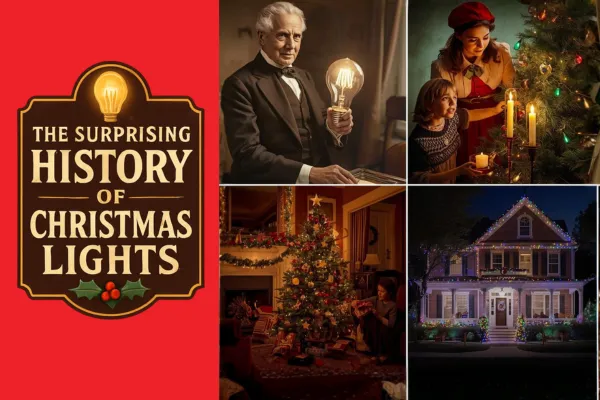
The Surprising History of Christmas Lights: From Edison's Invention to Your Greensboro Home
When you drive through a Greensboro neighborhood in December and see homes glowing with thousands of twinkling lights, it's hard to imagine that just 150 years ago, this magical tradition didn't exist. The story of Christmas lights is far more dramatic, dangerous, and innovative than most people realize. From open flames on evergreen branches to the professional LED installations that Triad Christmas Lights creates today, the evolution of holiday lighting reveals how one invention sparked a tradition that transformed the way we celebrate.
The Candlelit Era: A Dangerous Holiday Tradition
Before electricity, Christmas decorations were simple but treacherous. In 17th-century Germany, devout families would place lit candles directly onto evergreen branches during the Christmas season. The candles symbolized the triumph of light over darkness during the winter solstice—a deeply meaningful tradition with ancient roots.
However, candle-lit trees were catastrophically dangerous. Open flames in close proximity to dry evergreen needles created constant fire hazards. Homes burned down. Families lost everything. Yet despite the obvious dangers, the tradition spread throughout Europe and eventually made its way to America. For centuries, people accepted this risk as the price of holiday beauty. Church records from this era document tragic accounts of Christmas fires that claimed lives and destroyed homes.
The wealthy could afford servants to watch the candles closely and extinguish them before any flames got out of control. Poorer families simply had to hope for the best. Christmas morning often meant not only opening gifts but offering gratitude that the house had survived the night.

Edison's Invention: More Than Just a Lightbulb
Thomas Edison is credited with inventing the practical incandescent lightbulb in 1879, but few people know the full story of how his invention transformed Christmas. While Edison's bulb was revolutionary for household lighting, it took another creative mind to see its holiday potential.
In 1880, Edward Johnson, a colleague of Edison's, created the first electrically lit Christmas tree. Johnson hand-wired 80 small red, white, and blue incandescent bulbs and strung them on a tree in his New York home. He invited journalists to see this technological marvel, and they were astonished. The New York Times covered the story, and suddenly, America was captivated by the idea of electric Christmas lights.
However, Johnson's creation came at a staggering cost. The lights were incredibly expensive—equivalent to thousands of dollars in today's money. Only the wealthiest families could afford them. The general public had to content itself with watching wealthy neighbors display these glowing wonders, creating a stark divide between those who could afford electric lights and those who still relied on candles.
The First Commercial Christmas Lights: Birth of an Industry
The real turning point came in 1903 when the first commercial Christmas light strings became available to the public. Initially called "miniature Christmas lights," these strands were created specifically for decorative purposes. By the 1920s and 1930s, Christmas lights began appearing on homes and storefronts across America.
But early electric lights had their own problems. The strings were prone to catching fire. A single bulb failure would extinguish the entire strand. The wiring was exposed and dangerous, especially for households with children. Yet compared to the open-flame candle alternative, they were miraculous. Families embraced them enthusiastically, even if they came with electrical risks.
The Great Depression slowed the spread of Christmas lights, but after World War II, America experienced an explosion of holiday decorating. Returning soldiers settled into new suburban neighborhoods, prosperity returned, and Christmas lights became an essential part of the American dream. A lit-up house became a symbol of hope, success, and patriotism.

The Golden Age: 1950s-1980s
The post-war era was the golden age of Christmas lights. Manufacturers introduced safer designs, better insulation, and more reliable bulbs. The strings became affordable enough for middle-class families to purchase. Christmas light displays became neighborhood competitions, with families striving to create increasingly elaborate shows.
During the 1950s and 1960s, towns and cities across America began installing municipal holiday light displays. Department stores competed with extravagant window displays, each trying to outdo the others. The tradition that had started as a dangerous candle on a tree branch had evolved into a symbol of community celebration and commercial enterprise.
However, installation remained a DIY endeavor for most homeowners. Climbing ladders with strand after strand of heavy incandescent bulbs, dealing with tangled cords, and navigating the electrical challenges were part of the annual ritual—and part of the danger. Emergency rooms reported seasonal increases in injuries from falls, electrical burns, and shocks during the holiday season.
The LED Revolution: 1960s to Present
The light-emitting diode (LED) was invented in 1962, though it took decades before the technology became practical for Christmas lights. Early LEDs were expensive, single-colored, and produced weak light. But as technology improved throughout the 1980s and 1990s, LED Christmas lights became increasingly viable.
The real transformation happened in the early 2000s when manufacturers perfected warm-white LEDs and brought costs down to competitive levels. LEDs offered revolutionary advantages: they used 80% less energy than incandescent bulbs, lasted 25 times longer, produced virtually no heat, and were far safer. A strand of LED lights could be left on continuously for months without significant safety concerns.
Yet LED adoption was slow. Many consumers found the light quality initially cold and uninviting compared to the warm glow of traditional incandescent lights. Older homeowners in particular resisted what they saw as cold, artificial light replacing the warmth of traditional Christmas bulbs. But as LED technology improved and warm-white versions became available, the advantages became undeniable: lower electric bills, longer-lasting displays, and dramatically reduced fire risk.
Professional Christmas Light Installation: A Growing Industry
As LED technology made year-round or month-long displays practical and energy-efficient, a new industry emerged. Professional Christmas light installation companies began appearing across America in the 2000s and 2010s. This wasn't just about convenience—it was about safety, expertise, and design.
Companies like Triad Christmas Lights in Greensboro represent the modern evolution of this 150-year tradition. What started as families dangerously placing candles on tree branches has become a sophisticated service industry. Professional installers bring expertise in electrical safety, aesthetic design, and installation techniques that individual homeowners simply can't match.
Triad Christmas Lights serves Greensboro, Winston-Salem, High Point, Kernersville, and Oak Ridge with comprehensive services including custom design, professional installation, maintenance, removal, and storage. The company's work reflects more than a century and a half of accumulated knowledge about how to safely and beautifully illuminate a home during the holidays.
Modern professional installation addresses the exact problems that plagued Christmas light decorating for generations: ladder safety, electrical hazards, design challenges, and the sheer time commitment. When you hire a professional like Triad Christmas Lights, you're not just getting lights installed—you're benefiting from generations of innovation and safety improvement.

The North Carolina Tradition
Christmas lighting has a special place in North Carolina culture. The mild winters in the Greensboro area allow for extended display seasons compared to northern states. Duke Energy customers in the region can enjoy displays well into January without the weather damage that affects colder climates. Yet North Carolina's humidity and occasional ice storms create their own challenges for light installation and storage.
This is where local expertise matters. Triad Christmas Lights understands the specific climate considerations that Greensboro homeowners face. The company knows how to select, install, and store LED lights in a way that accounts for North Carolina's moisture and temperature fluctuations. What works in Michigan or Colorado needs adjustment for the Triad region.
Why This History Matters Today
Understanding the history of Christmas lights helps us appreciate what we have. For centuries, people risked their homes and lives to create a simple glowing display. They endured electrocution risks, spent enormous sums of money, and climbed dangerous ladders. Each innovation—from Edison's bulb to LED technology to professional installation services—represented an attempt to make Christmas lighting safer, more beautiful, and more accessible.
Today's homeowners have unprecedented options. You can choose professional installation from companies like Triad Christmas Lights, enjoy safer and more energy-efficient LED technology, display your lights for months without worry, and create custom designs that would have been impossible just decades ago. The 150-year journey from dangerous candle flames to professionally designed LED displays represents human ingenuity and the importance of making holiday traditions safer and more enjoyable for everyone.
The tradition continues to evolve. Smart lighting systems now allow you to program synchronized displays. Outdoor entertainment integrates with holiday lighting. Ring doorbells capture footage of people admiring your display. Yet at its core, Christmas lights still serve the same purpose they have for centuries: to spread joy, celebrate hope, and transform our homes into places of magic and wonder during the darkest time of year.
When you look at a beautifully lit home in Greensboro this holiday season, you're seeing the culmination of 150 years of innovation, safety improvements, and artistic refinement. Whether you choose to install lights yourself or work with Triad Christmas Lights, you're participating in a tradition that has captivated humanity since the first brave soul decided that light was worth the risk.

What were the first Christmas lights made of, and why did people use them if they were so dangerous?
The original "Christmas lights" were actual open flames—candles placed on evergreen branches. People used them because Christmas has ancient roots in celebrating the winter solstice, and light has always symbolized hope and triumph over darkness. Despite the obvious fire hazard, the tradition was so meaningful that families accepted the risk. It wasn't until Edison's lightbulb became practical that people finally had a safer alternative that captured the same magical quality.
Did Thomas Edison actually invent Christmas lights?
Not exactly. Thomas Edison invented the practical incandescent lightbulb in 1879, but Edward Johnson, one of Edison's employees, created the first electrically lit Christmas tree in 1880. Johnson hand-wired 80 bulbs and created the concept that inspired the commercial Christmas light industry. So while Edison's invention made it possible, Johnson deserves credit for the Christmas light application specifically.
When did Christmas lights become affordable for average families?
The first commercial Christmas light strings became available around 1903, but they were still expensive. It wasn't until after World War II, in the 1950s, that middle-class families could regularly afford to purchase Christmas light strands. The post-war prosperity and suburban explosion made Christmas lights a standard holiday tradition by the 1960s and 1970s.
What's the difference between incandescent and LED Christmas lights, and why should I care?
Incandescent lights work by heating a filament until it glows, which produces warm light but uses significant electricity and generates heat. LEDs (light-emitting diodes) produce light through a semiconductor and use about 80% less energy. LEDs last 25 times longer, produce almost no heat, are safer, and are more environmentally friendly. The main disadvantage historically was that early LEDs produced cold-looking light, but modern warm-white LEDs have solved this problem.
Are old-fashioned incandescent Christmas lights actually more dangerous than LED lights?
Yes, considerably. Incandescent lights generate heat, which can ignite nearby materials, and the older designs had exposed wiring and poor insulation. A single bulb failure could start a fire. LEDs produce virtually no heat, are better insulated, and are far more reliable. This is one reason why professional companies like Triad Christmas Lights recommend LED technology for any display that will remain up for extended periods.
How do North Carolina's weather conditions affect Christmas light installation and storage?
North Carolina experiences high humidity, temperature fluctuations, and occasional ice storms. The humidity can damage connections and corrode metal fixtures if lights aren't properly stored. This is why Triad Christmas Lights recommends specific storage practices for the Greensboro area. Professional installers understand how to select materials and installation methods that account for regional climate challenges, which can add years to the life of your display.
Did people really decorate Christmas trees with electricity before consumer lights were available?
Yes, but only the extremely wealthy could afford it. Edward Johnson's custom-wired tree in 1880 was a marvel seen by the very rich. The first commercial strings were still prohibitively expensive. Most families didn't have electric Christmas tree lights until the 1950s. This created a significant class divide—having electric Christmas lights was literally a status symbol for much of the early 20th century.
What's the benefit of hiring a professional company like Triad Christmas Lights instead of doing it myself?
Professional installation offers several advantages that go far beyond convenience. Triad Christmas Lights brings expertise in electrical safety, custom design, and installation techniques. Professionals have the proper equipment to access high areas safely, understand how to protect your home's electrical system, can design displays that complement your specific property, and handle all setup and removal. They also manage seasonal storage, which is particularly important in North Carolina's climate. Most importantly, they eliminate the safety risks associated with DIY installation—falls from ladders cause thousands of injuries annually.
