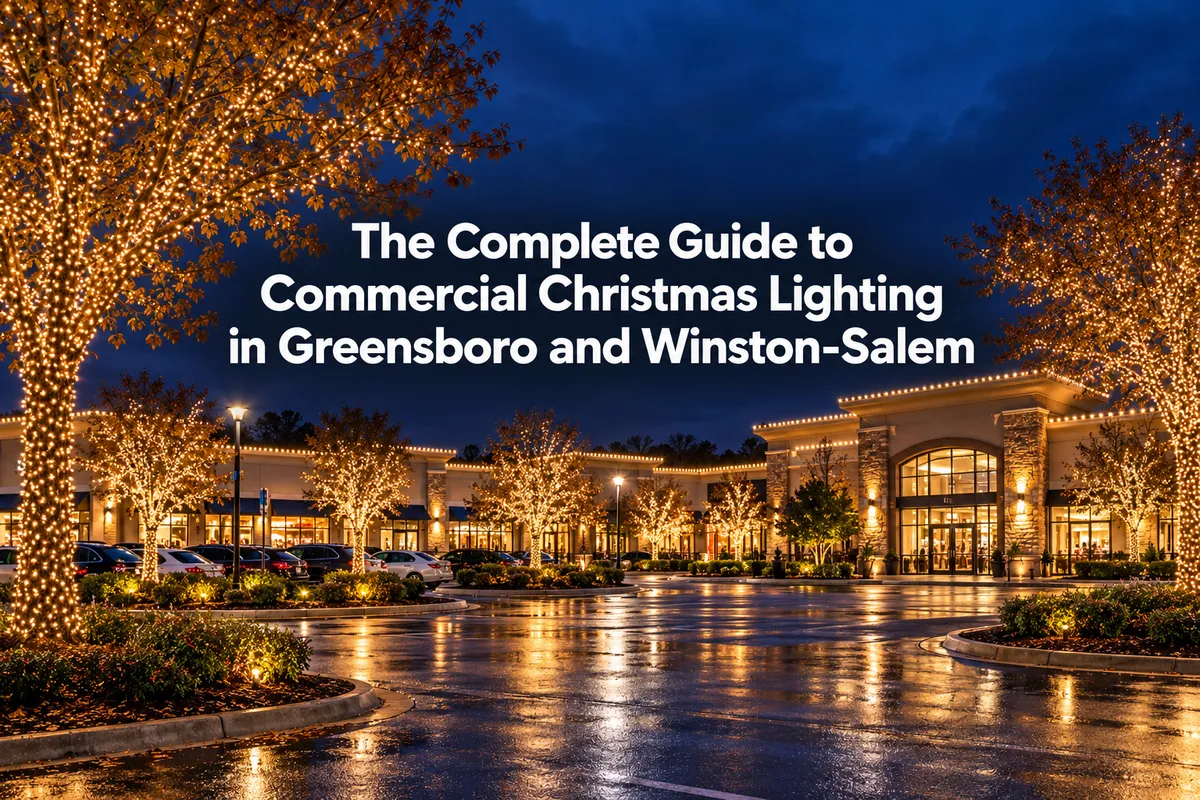
The Complete Guide to Commercial Christmas Lighting in Greensboro and Winston-Salem
Commercial holiday lighting is a different business than residential holiday lighting. It runs on different timelines, different equipment, different insurance requirements, and a completely different set of stakes. When a homeowner's lights go dark for a night, it's an annoyance. When a shopping center's lights go dark the Friday after Thanksgiving, it costs real money.
If you manage a retail property, office building, restaurant, church, hotel, HOA common area, or any commercial space in the Triad, this guide covers what you actually need to know before you sign a contract — how the process works, what drives cost, what timelines look like, and what separates a professional commercial installation from a crew with ladders and good intentions.
Triad Christmas Lights handles commercial holiday lighting across Greensboro, Winston-Salem, High Point, Kernersville, and Oak Ridge. Here's how the commercial side of this industry works.
Commercial Isn't Just Residential at a Bigger Scale
This is the most common misunderstanding, and it leads property managers to hire the wrong contractor every year.
A residential install is a single decision-maker, one structure, standard ladder access, a straightforward electrical situation, and a homeowner who's flexible if weather pushes the date. A commercial install is none of those things.
Commercial work typically involves multiple stakeholders — a property manager, a corporate marketing team, maybe a tenant association, maybe a national brand standard that has to be followed. It involves buildings tall enough to require lifts rather than ladders. It involves electrical loads that have to be calculated and distributed across circuits that are already carrying a building's operations. It involves working around business hours, customer traffic, delivery schedules, and parking constraints. And it involves a deadline that genuinely cannot move, because the retail calendar doesn't care about rain.
It also involves liability. A commercial property owner has exposure that a homeowner doesn't. Anyone working at height on your property needs to carry proper general liability and workers' compensation coverage, and you need to see the certificates. Every serious commercial lighting contractor in the Triad expects to be asked for those documents. If one hesitates, that tells you everything.
What Commercial Christmas Lighting Actually Covers
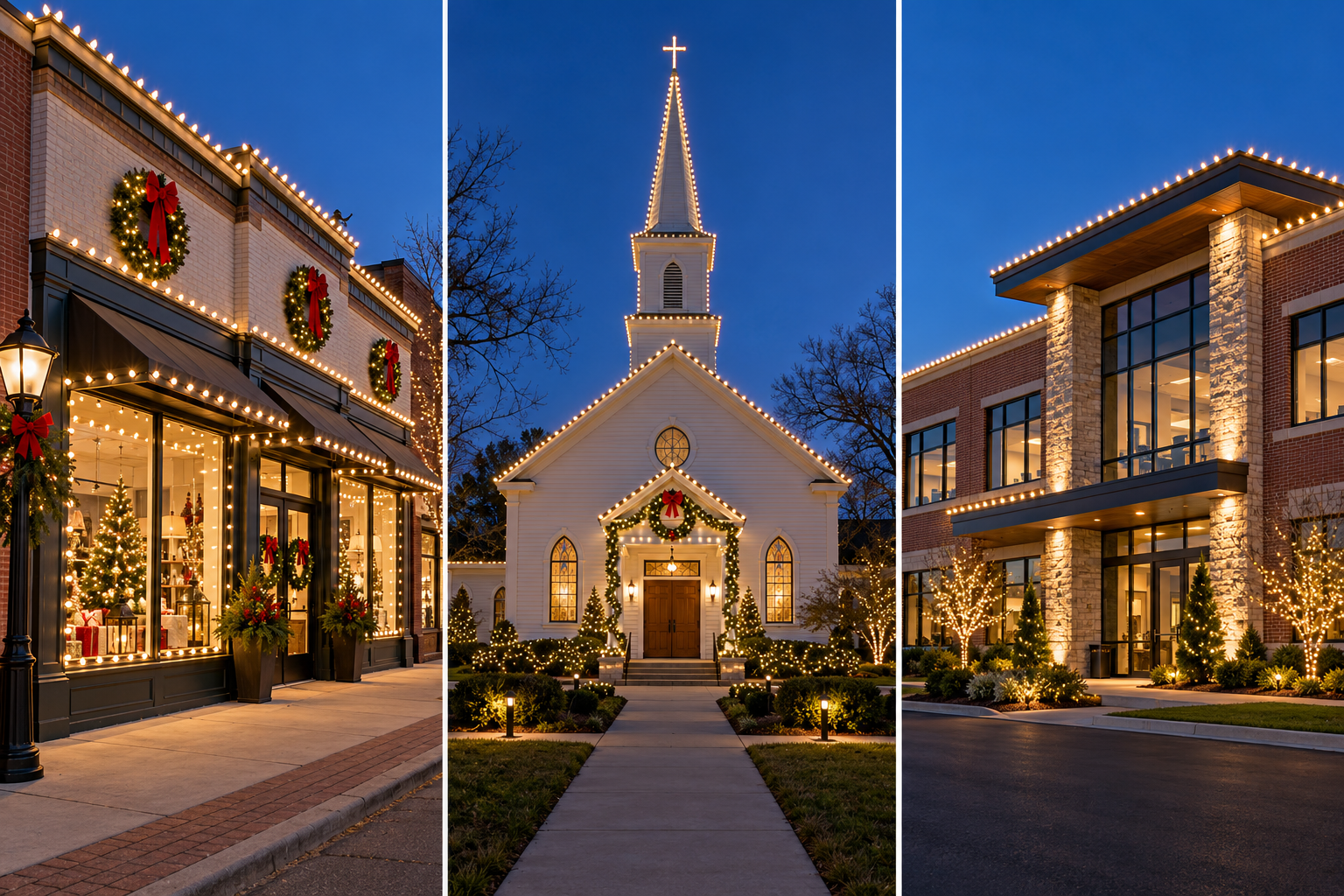
The category is broad, and most Triad businesses fall into one of these buckets.
Retail and shopping centers. Storefronts, entry canopies, parking lot tree wraps, median lighting, and shared common areas. The goal is drawing traffic and creating a destination feel during the highest-revenue weeks of the year.
Office buildings and corporate campuses. Rooflines, entry features, lobby-adjacent exterior lighting, and landscape lighting along approach drives. Usually more restrained aesthetically — warm white, clean lines, brand-appropriate.
Restaurants and hospitality. Patio and outdoor dining areas, entry features, awnings, and signage lighting. Restaurants often want more warmth and character than a corporate office, and outdoor dining spaces have become a much bigger part of the equation in the Triad than they were a decade ago.
Churches. Steeples, columns, entry arches, and landscape features. Churches in Greensboro and Winston-Salem often run the most ambitious displays in their neighborhoods, and they need them reliable through Christmas Eve services.
HOAs and multi-family communities. Entrance monuments, clubhouse buildings, shared greenspace trees, and amenity areas. Board-driven decisions, so timelines run longer on the approval side.
Hotels and event venues. Porte-cochères, exteriors, courtyards, and anything guests photograph. Hotels tend to want the display up earliest, because holiday bookings start in November.
Auto dealerships and large lots. Perimeter lighting, building outlines, and lot tree work. Visibility from the road is the whole point.
Triad Christmas Lights works across all of these property types, and the design approach differs meaningfully for each.
The Commercial Timeline: Why You're Already Behind
Here's the schedule reality for commercial work in the Triad.
Spring and summer is when large properties with multi-year contracts and big budgets lock in scope. Corporate approval cycles are slow, and multi-property portfolios need coordination.
August and September is prime booking season for most commercial clients. Design consultations happen, quotes go through approval, and materials get ordered. Custom items — oversized wreaths, branded color schemes, specialty channel systems, large-format decor — have real lead times, and ordering them in September is what makes them possible in November.
October is when commercial installs actually begin. This is the single most important scheduling difference between commercial and residential. Commercial properties get installed before residential, because their deadline is earlier and their scope is larger.
Early November is the target completion window for most retail. Lights need to be tested, adjusted, and fully operational before Black Friday. If your property is customer-facing and generates holiday revenue, your display should be live no later than the second week of November.
Mid-November through December is monitoring and maintenance — service calls, bulb replacements, weather repairs.
January is takedown, and it needs to be scheduled as carefully as installation. Retail properties generally want lights down quickly once the season closes.
If you're reading this and it's already fall, the honest answer is that scope matters. A modest storefront can often still be accommodated. A full shopping center with custom materials probably cannot be built from scratch this late. Call and ask rather than assuming either way.
What Drives Commercial Pricing
Commercial quotes vary enormously because commercial properties vary enormously. These are the factors that actually move the number.
Linear footage and building height. The single biggest driver. Roofline footage sets material cost, and height determines whether the job needs ladders, a boom lift, or a scissor lift — which changes labor cost substantially.
Access difficulty. A building surrounded by open parking is straightforward. A building with landscaping, elevated walkways, limited lift staging area, or overhead obstructions takes significantly longer.
Electrical infrastructure. Some commercial buildings have exterior circuits in convenient locations. Many don't. Running power properly, distributing load across circuits, and adding timers or controls adds cost but prevents the tripped-breaker problem that plagues cheap installs.
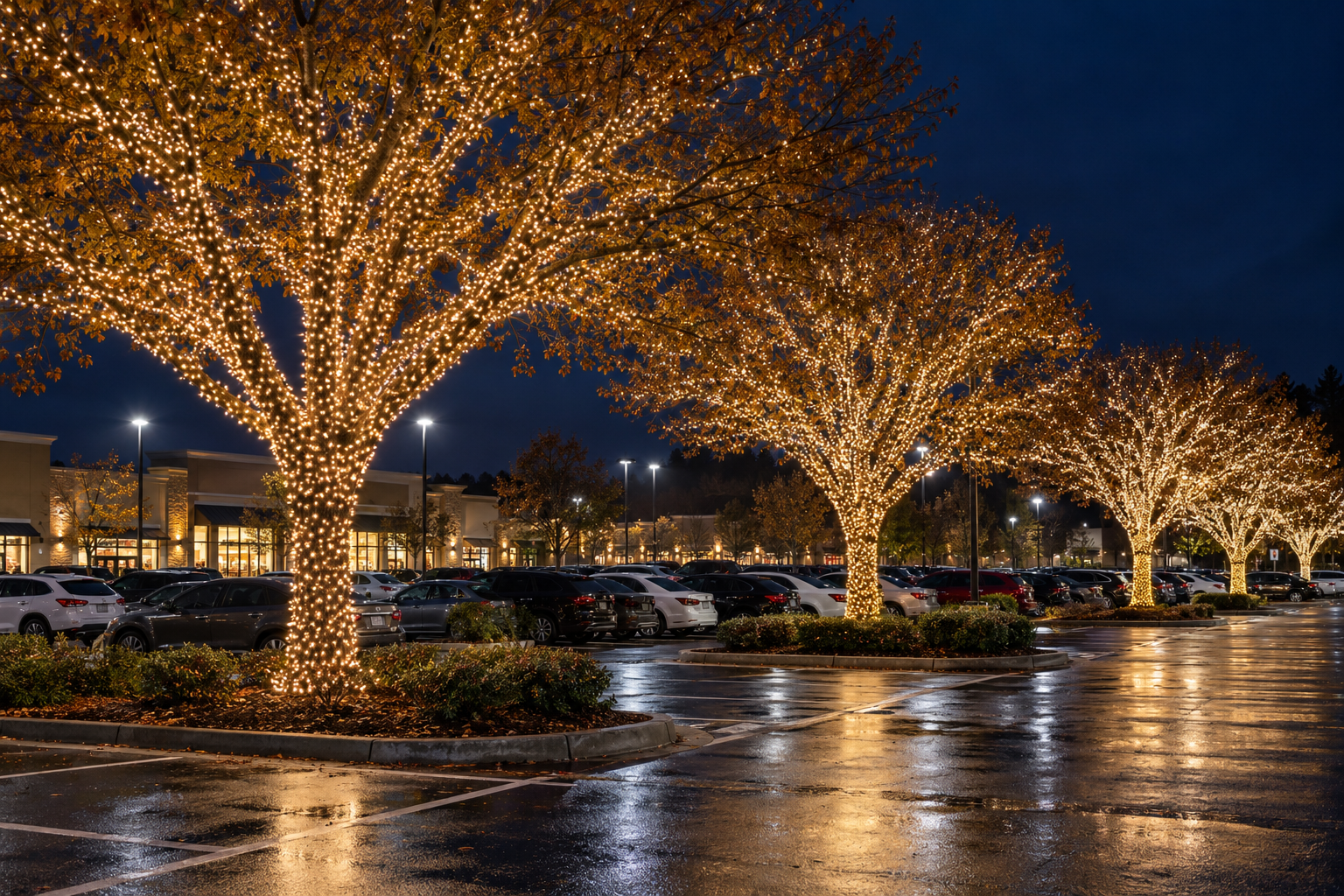
Tree work. Wrapping mature trees is labor-intensive and material-intensive. A parking lot full of wrapped trees can easily exceed the cost of the building itself.
Design complexity. Standard warm-white roofline lighting is the baseline. Color schemes, animation, custom decor, branded elements, and architectural feature lighting all add.
Service level. Most commercial agreements include in-season maintenance, which is what you're really buying. A display with no service commitment is not a commercial product.
Multi-year agreements. Many Triad commercial clients sign multi-year terms, which typically improves pricing because material investment amortizes across seasons and scheduling is guaranteed.
Ask for a quote that itemizes design, materials, installation, in-season service, takedown, and storage separately. A single lump number tells you nothing about what happens when something breaks in December.
Safety, Insurance, and Liability
This section matters more than the aesthetics, and it's where the gap between professional and amateur contractors is widest.
Commercial installation regularly involves working at heights above twenty feet, often from aerial lifts, often in cold and wet conditions, and often in areas with customer and employee traffic below. The risk profile is real.
What to verify before anyone sets foot on your property: current general liability insurance with adequate limits, workers' compensation coverage for every person on the crew, documented lift operation training, and a plan for pedestrian and vehicle safety during installation. Ask for certificates of insurance naming your property. This is standard practice and no legitimate contractor will be surprised by the request.
Electrical safety deserves specific attention. Commercial-grade holiday lighting uses commercial-grade materials — properly rated connectors, correct gauge extension runs, GFCI protection, and calculated load distribution. Big-box residential product daisy-chained across a commercial building is a genuine fire and shock hazard, and it's more common than it should be.
Triad Christmas Lights uses commercial-grade LED product throughout, which matters both for safety and for the humidity and temperature swings that North Carolina delivers every winter.

Why Commercial-Grade LED Matters in North Carolina
The Triad's climate is genuinely hard on holiday lighting. Humidity is high, temperatures swing above and below freezing repeatedly through December and January, and the region catches the occasional ice event.
Commercial LED product is built for this. Sealed connections resist moisture intrusion. Higher-quality bulbs and wiring survive thermal cycling without failing. Proper commercial installations use clips and mounting methods designed for the specific surface — not staples driven into fascia, not adhesive that releases in cold weather.
The energy side matters too at commercial scale. A large property running incandescent product burns meaningfully more electricity than the same display in LED, and on a Duke Energy commercial rate across six to eight weeks of nightly operation, that difference shows up on a bill. LED also runs cooler, which reduces risk on and near combustible surfaces.
The Commercial Installation Process, Step by Step
Site assessment. A walkthrough of the property with measurements, electrical evaluation, access assessment, and discussion of goals and constraints. This is where scope actually gets defined.
Design and proposal. A specific design with materials, layout, and itemized pricing. For larger properties this often includes renderings or reference imagery so stakeholders can approve something concrete.
Approval and scheduling. Once approved, your installation date is locked and materials are ordered. For properties with corporate approval chains, build time into this step.
Material prep and staging. Product is measured, cut, assembled, and tested before it ever reaches your property. Good commercial contractors don't show up and improvise.
Installation. Executed around your business hours, typically early morning or during low-traffic periods. Lift staging, safety perimeters, and crew coordination are planned in advance.
Testing and walkthrough. The full display is tested, timers and controls are set, and a walkthrough confirms everything matches the approved design.
In-season maintenance. Service calls handled during the season for outages, weather damage, or adjustments.
Takedown and storage. Scheduled removal in January, with materials stored for the following season under most commercial agreements.
Serving the Triad
Commercial holiday lighting demand across Greensboro, Winston-Salem, High Point, Kernersville, and Oak Ridge is concentrated into a narrow window, and lift availability, crew capacity, and material lead times all compress at the same time. Properties that book in late summer and early fall get the October install dates that make a Black Friday deadline comfortable rather than tight.
Triad Christmas Lights builds commercial schedules geographically, and works with property managers, business owners, church leadership, and HOA boards across all five markets.

When should a commercial property book Christmas lighting?
Late summer through September is ideal, with installation running in October. Commercial properties install before residential because their deadlines are earlier and scope is larger. Waiting until November usually means limited availability and no custom materials.
How much does commercial Christmas light installation cost in Greensboro?
It depends heavily on linear footage, building height, access difficulty, tree work, and design complexity. A single storefront and a multi-building shopping center are entirely different projects. Every commercial quote starts with a site assessment, because guessing from a photo produces numbers that don't hold up.
Do you carry insurance for commercial work?
Yes, and you should ask every contractor you consider for current certificates of general liability and workers' compensation coverage before work begins. Commercial holiday lighting involves work at height and electrical work — verifying coverage protects your property.
Can you install during business hours?
Installations are typically scheduled around your operating hours, often early morning or during low-traffic periods, with safety perimeters set up to keep customers and employees clear of work areas.
What happens if lights go out during the season?
In-season maintenance is a standard part of commercial agreements. Outages, weather damage, and adjustments are handled through scheduled service calls so your display stays operational through the holiday period.
Can you match our brand colors?
Yes. Custom color schemes are common on commercial projects, though they require lead time for material ordering. This is a significant reason to start the conversation in late summer rather than fall.
Do you handle multi-property portfolios?
Yes. Multiple locations across the Triad can be coordinated under a single agreement with scheduling built around each property's deadline and access constraints.
Do you handle takedown and storage?
Yes. Removal is scheduled in January, and commercial agreements typically include storage of materials for the following season.
